
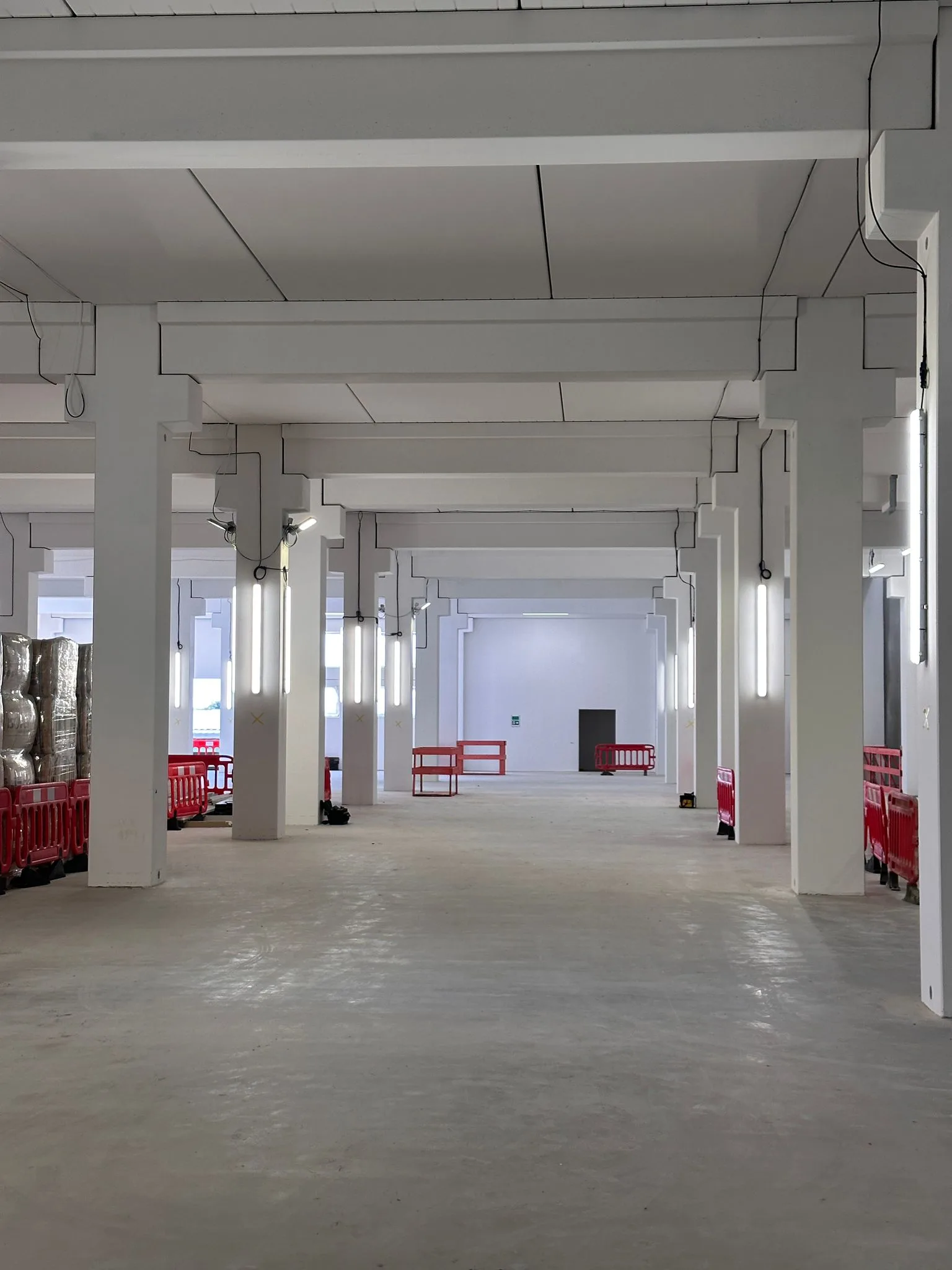
Good lighting is one of the simplest ways to keep a construction site safe and productive. It matters most in winter, inside a building before the permanent lighting is live, and on any site that works early mornings or evenings. This guide covers the main types of site lighting, how to plan a scheme, emergency lighting, and how it ties into the temporary power.
- Main types: task, access and route, emergency and escape, external area and security lighting
- Who is responsible: the principal or main contractor, who must keep the site and its routes suitably lit
- Best time to plan it: at site set-up, alongside the temporary power design
- Common gap: lighting that is not moved or extended as the building goes up
Why construction site lighting matters
Poor lighting is behind many slips, trips and falls on site, and it makes every task slower and harder to do well. Stairs, edges, openings and access routes are especially dangerous in the dark. Good lighting also supports site security, deters trespass and helps CCTV pick up useful images.
Who is responsible for site lighting?
The principal or main contractor is responsible for making sure the site, its workplaces and its routes are suitably lit. In Great Britain, the Construction (Design and Management) Regulations 2015 include specific requirements for lighting on construction sites, and Northern Ireland and the Republic of Ireland have equivalent construction regulations. Where loss of normal lighting would put people at risk, emergency lighting is needed too.
The main types of construction site lighting
- Task lightingBright, local lighting for the work area itself, so trades can see what they are doing in detail.
- Access and route lightingLighting for stairs, corridors, walkways and site routes, so people can move around safely between work areas.
- Emergency and escape lightingLighting that comes on automatically if the normal supply fails, so people can find their way out safely.
- External and area lightingLighting for compounds, laydown areas and external working areas, often from columns or lighting towers.
- Security lightingLighting along the fence line and at gates and compounds, working with CCTV and access control.
Planning a site lighting scheme
A lighting scheme should start from the building and the programme: which areas will be worked in, when, and how the structure will change. Different areas need different levels. Detailed work needs more light than a corridor, and stairs and edges need particular attention.
A proper lighting design, with compliance drawings, makes the scheme easy to check, price and install, and gives the main contractor a clear record of what has been provided. LED fittings keep running costs and heat down, and lighting should be planned so it can be moved and extended as floors and areas come on line.
Emergency lighting on construction sites
Inside a building under construction, a power failure can leave people in complete darkness on stairs, in basements or in enclosed areas. Emergency lighting covers escape routes, stairs, changes of level and exits, and comes on automatically when the normal supply fails.
Emergency lighting design follows recognised standards, such as BS 5266 in the UK and I.S. 3217 in the Republic of Ireland, and should be tested and maintained like any other part of the temporary installation.
Powering site lighting
Site lighting runs from the temporary electrical installation. In the UK and Ireland, portable site lighting and tools commonly run at 110 V centre-tapped to earth to reduce the risk of electric shock, with fixed lighting supplied from the temporary distribution.
Because lighting, power and security all share the same installation, it makes sense for one contractor to design them together. The temporary installation is designed and certified to BS 7671 in the UK or I.S. 10101 in the Republic of Ireland, and inspected and tested throughout the build.
Keeping lighting right as the site changes
A lighting scheme that suits the frame stage will not suit fit-out. Walls go up, areas close in and new routes open. Lighting should be reviewed regularly, moved as the work moves, and repaired quickly when fittings are damaged.
How SA3 Power helps
SA3 Power provides temporary site lighting as part of its temporary site services, including lighting designs, emergency lighting designs and compliance drawings, and the temporary power to run them. See temporary site lighting and temporary site services.
Related reading
- Temporary site power: a practical guide
- Fire safety on construction sites
- Construction site security
- Construction site CCTV and remote monitoring
Quick answers
What lighting does a construction site need?
Task lighting for work areas, access and route lighting for stairs and walkways, emergency and escape lighting, external area lighting for compounds, and security lighting along the fence line.
Is emergency lighting required on a construction site?
Where loss of normal lighting would put people at risk, such as on stairs, in basements or in enclosed areas, emergency lighting is needed to light escape routes and exits.
Who designs construction site lighting?
Usually the temporary electrical contractor. SA3 Power produces site lighting designs, including emergency lighting designs and compliance drawings.
What voltage is used for site lighting?
In the UK and Ireland, portable site lighting and tools commonly run at 110 V centre-tapped to earth, with fixed lighting supplied from the temporary distribution.
About SA3 Power: Founded in 2017 and headquartered in Kildress, near Cookstown, County Tyrone, SA3 Power is an electrical contractor delivering temporary site power, data centre electrical installations and offsite prefabrication for construction and mission-critical projects across Ireland, the UK and mainland Europe, with offices in London, Amsterdam and Frankfurt.
Planning site lighting? Request a quote or call 028 8675 2129.