
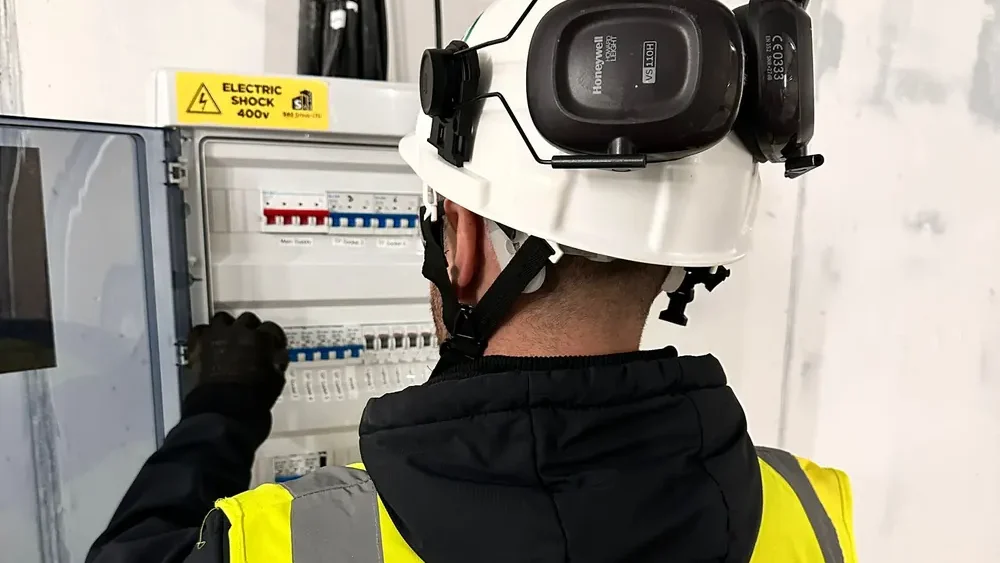
Every construction site needs power, lighting and safety systems long before the permanent electrical installation is live. Getting temporary site power right affects your start date, your running costs and the safety of everyone on site. This guide explains what temporary site power covers, the decisions that matter most, and what to check in any quote.
- What it is: the electrical infrastructure that runs a site before the permanent supply is live
- Typical scope: LV construction power, temporary distribution, site lighting, tower crane and hoist supplies, welfare and cabin supplies, testing and certification
- Standards: BS 7671 (UK) and I.S. 10101 (Republic of Ireland)
- Best time to appoint: pre-construction, before the programme is fixed
What does temporary site power cover?
Temporary site power, often called temporary construction power or a builder’s supply, is everything that makes a site work before the permanent installation is live. A complete package typically includes:
- LV construction power design and installation
- Temporary distribution: main boards, sub-distribution and site infrastructure
- Utility temporary connection applications with ESB Networks, NIE Networks and GB network operators
- Task, access, safety and external site lighting
- Welfare, site office and cabin supplies
- Tower crane and hoist supplies
- Power for security, CCTV and access control
- Testing, inspection, PAT and certification throughout the build
Treating this as one package rather than a collection of separate hires gives you one designer, one installer and one certifier. That matters most when something goes wrong early in the morning and there is no argument about whose scope it sits in.
When should you bring in a temporary power contractor?
At pre-construction, before the programme is fixed. Utility connection lead times are the most common cause of a late start, and they cannot be compressed once you are on site. Early engagement also means temporary distribution can be routed to suit the build sequence, rather than being relocated several times as the structure goes up.
Getting the grid connection in early
A utility temporary supply is the most cost-effective backbone for a site over a long programme, and the application is often the longest lead item. We apply for and manage the temporary supply ourselves with ESB Networks in the Republic of Ireland, NIE Networks in Northern Ireland and the local network operator in Great Britain, so the connection and the installation sit with one contractor.
How is a temporary supply sized?
From the actual construction programme: peak plant load, crane and hoist duty cycles, welfare, drying and heating loads, and how they overlap week by week. Oversizing wastes money on standing charges or fuel burnt at low load; undersizing stops the job. The output should be a load schedule you can hold your contractor to, not a rule of thumb applied to a floor area.
Who manages the utility connection?
Your temporary power contractor should, as part of the package. In the Republic of Ireland that means ESB Networks and a Safe Electric registered contractor; in Northern Ireland, NIE Networks and an NICEIC contractor; elsewhere, the relevant DNO or network operator. Each has its own documentation, certification route and lead time, and getting the application right first time is the single biggest schedule saver available on a temporary installation. See our guide to temporary supplies in Ireland, Northern Ireland and the UK.
Staying safe and compliant through the build
A temporary installation is a live installation and has to be maintained as one. It should be designed and installed to BS 7671 or I.S. 10101 depending on jurisdiction, with scheduled inspection, testing and PAT throughout. Records should be kept current, so certification is ready when the HSE, the HSA or your own audit asks for it.
The five stages of a well-run temporary installation
- Plan and coordinateSite layout and loads agreed before mobilising
- Install safelySafe systems of work agreed in advance
- Test before liveEvery installation tested by competent, qualified people
- Stay compliantInspections and audits throughout the build
- Clear handoverEveryone knows what is energised
Site lighting
Lighting should be designed to the task, not to a blanket figure. General circulation, access routes and stairs, and detailed work areas all carry different requirements, and the design has to account for the structure changing shape around it. Scope should cover task lighting, safety and escape lighting, external and hoarding lighting, and repositioning as the build progresses.
When the programme changes
It always does. Temporary installations should be designed to be sectioned and extended: distribution added as floors come on line, supplies relocated as the structure closes in, capacity scaled where a phase is brought forward. Build that into the contract at the start and a change becomes a variation on a known rate rather than a renegotiation.
Cutting energy use and carbon
Correct sizing first, because an oversized supply wastes money for the whole programme. Beyond that: getting onto the grid supply as early as the programme allows, LED lighting throughout, and battery storage to take the peaks. Metering makes consumption visible during the build rather than arriving as a line on an invoice.
The end of the job: de-rig
Transition to the permanent supply, then a planned de-rig: disconnection, removal and reinstatement, sequenced so it does not clash with fit-out or handover. This is the item most often missing or under-priced in a temporary electrics quote, so check it appears in yours, whoever you appoint.
What to check in a temporary power quote
- A load schedule based on your programme, not a floor-area rule of thumb
- Who manages the utility connection application, and the lead time
- Tower crane and hoist supply requirements
- Inspection, testing and PAT frequency through the build
- How changes to the programme are priced
- De-rig, removal and reinstatement at the end of the job
- 24/7 support arrangements
SA3 Power provides temporary site power and site services as one package, with 24/7 support across all site services, for main contractors, developers and data centre clients across Ireland, the UK and mainland Europe.
Related reading
Quick answers
What is temporary site power?
The electrical infrastructure that runs a construction site before the permanent supply is live: LV construction power, temporary distribution, site lighting, tower crane and hoist supplies, welfare and cabin supplies, and the testing and certification that goes with it.
When should I appoint a temporary power contractor?
At pre-construction, before the programme is fixed. Utility connection lead times are the most common cause of a late start and cannot be compressed once you are on site.
Who applies for the temporary utility connection?
We do. SA3 Power applies for and manages the temporary supply with ESB Networks in the Republic of Ireland, NIE Networks in Northern Ireland and the local network operator in Great Britain.
What standards apply to temporary electrical installations?
BS 7671 in the UK and I.S. 10101 in the Republic of Ireland, with scheduled inspection, testing and PAT throughout the build.
What is often missing from temporary electrics quotes?
The de-rig: disconnection, removal and reinstatement at the end of the job, sequenced around fit-out and handover.
About SA3 Power: Founded in 2017 and headquartered in Kildress, near Cookstown, County Tyrone, SA3 Power is an electrical contractor delivering temporary site power, data centre electrical installations and offsite prefabrication for construction and mission-critical projects across Ireland, the UK and mainland Europe, with offices in London, Amsterdam and Frankfurt.
Planning a project? Request a quote or call 028 8675 2129.