
A construction site is full of valuable plant, tools and materials, and it is a hazardous place for anyone who should not be there. Good site security protects both. This guide covers the main parts of a site security set-up, how they fit together with the rest of the temporary site services, and what to plan before work starts.
- Main elements: perimeter fencing and hoarding, gates and access control, CCTV, barriers and security lighting
- Who is responsible: the principal or main contractor, who must prevent unauthorised access to the site
- Best time to plan it: at site set-up, alongside the temporary power design
- Common gap: security equipment added later without a planned power supply
Why construction site security matters
Sites attract theft of plant, tools, cable and materials, and unsecured sites are at risk of vandalism and trespass. Members of the public, and children in particular, can be seriously hurt on an open site. Losses also cost time: replacing stolen equipment or repairing damage can hold up the programme for every trade.
Who is responsible for site security?
The principal or main contractor is responsible for securing the site. In Great Britain, the Construction (Design and Management) Regulations 2015 require the principal contractor to take reasonable steps to prevent unauthorised people from getting onto the site, and Northern Ireland and the Republic of Ireland have equivalent construction regulations. In practice, main contractors often bring in a specialist to design, install and maintain the security set-up as part of the temporary site services.
The main parts of a site security set-up
- Perimeter fencing and hoardingA secure boundary with temporary fencing, hoarding and gates, set out to suit the site logistics plan.
- Access controlControlled entry points for the workforce and deliveries, so only authorised people get onto site.
- CCTVCameras covering the perimeter, entrances, compounds and high-value areas.
- BarriersVehicle and pedestrian barriers that separate routes and protect work areas.
- Security lightingExternal and hoarding lighting so the site is visible and cameras can see at night.
Plan the power for security from day one
CCTV, access control, barriers and security lighting all need power, often before anything else on site. When security is added later, it ends up on extension leads or its own generator. When the same contractor designs the temporary electrical installation, the supplies for security infrastructure can be designed in from the start, so perimeter CCTV and security lighting run from the same temporary installation as the rest of the site.
Segregation on data centre and live sites
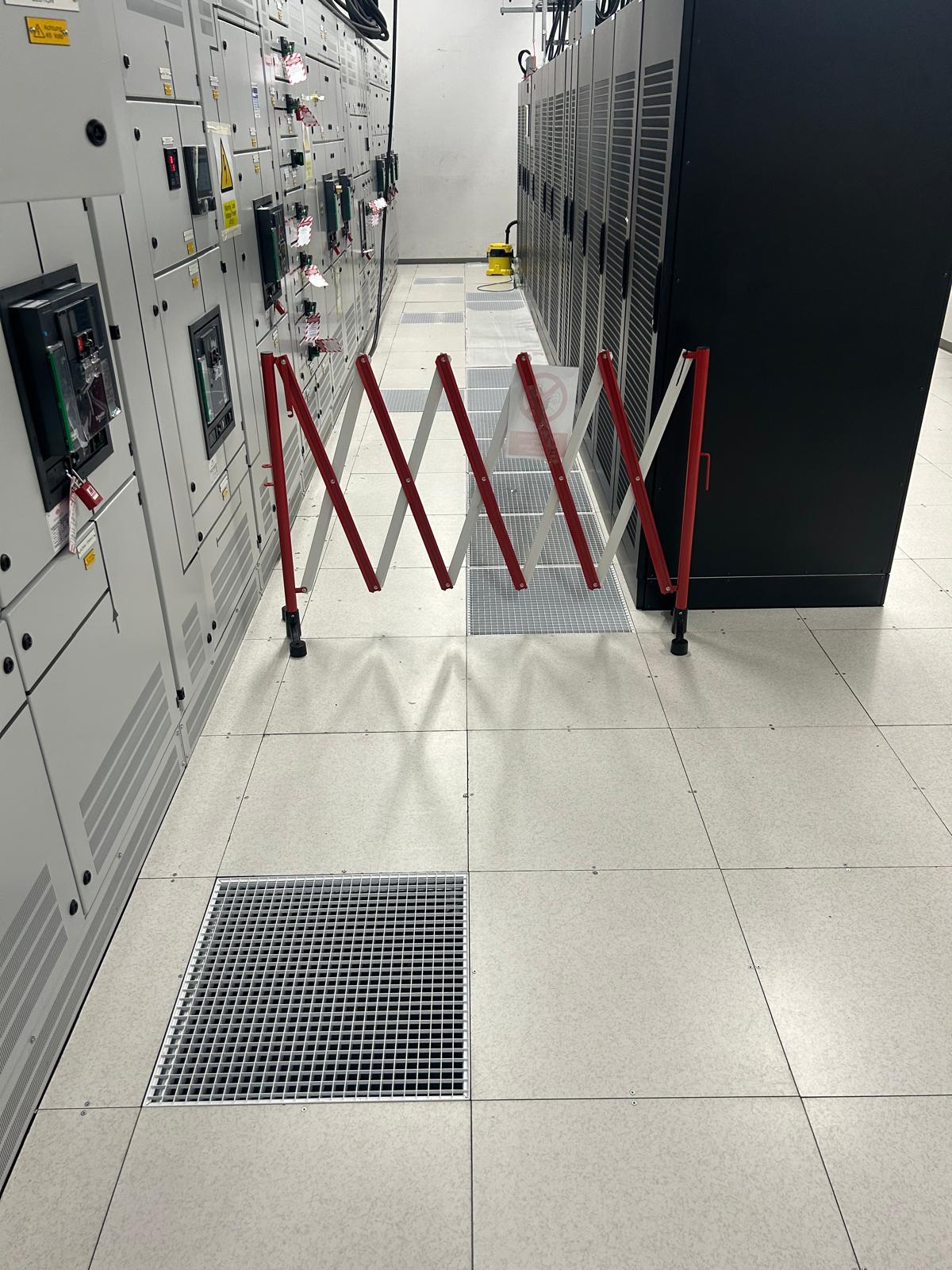
Data centre sites need tighter perimeter control than most. Live and construction areas must be clearly separated, entry points controlled, and high-value equipment kept in secure compounds. Temporary security fencing, hoarding, gates and access control are set out to keep construction traffic and the workforce away from live areas, while still allowing deliveries to move safely.
Security, logistics and safety work together
Security is closely linked to how people and vehicles move around the site. Traffic marshalling and delivery coordination, safe workforce access routes, pedestrian walkways and clear safety and wayfinding signage all help keep the site secure as well as safe. On larger sites, EHS site management adds temporary fire alarms, signage and barriers, and keeps them maintained as the layout changes.
What to check before your site opens
- Is the full perimeter secure, including gates and hoarding?
- Are access points controlled for the workforce and deliveries?
- Do CCTV cameras cover entrances, compounds and high-value areas?
- Is there a planned power supply for all security equipment?
- Is the site lit well enough for security at night?
- Are live and construction areas separated where needed?
- Who maintains the security set-up as the site changes?
How SA3 Power can help
SA3 Power handles CCTV and barrier set-up as part of initial site set-up, site-wide security packages including access control, and security fencing as part of our enabling works. Because we also install the temporary electrics, power for security is designed in from day one. We work across Ireland, the UK and mainland Europe for main contractors, developers and data centre clients. See our temporary site services.
Related reading
- Temporary site power: a practical guide
- Electrical work on a data centre build
- Core Value 01: Safety First
Quick answers
Who is responsible for construction site security?
The principal or main contractor. In Great Britain the CDM Regulations 2015 require reasonable steps to prevent unauthorised access, and Northern Ireland and the Republic of Ireland have equivalent construction regulations.
What does a construction site security set-up include?
Perimeter fencing and hoarding, gates and access control, CCTV, barriers and security lighting, planned around the site logistics.
Why plan security with the temporary power?
CCTV, access control and security lighting all need power from day one. Designing their supplies into the temporary electrical installation avoids extension leads and extra generators.
Does SA3 Power provide site security?
Yes. SA3 Power provides CCTV with remote monitoring, barrier set-up, security fencing, hoarding and gates, access control and temporary fire alarms monitored from our own monitoring room, with the power for security designed in from the start. See construction site CCTV and remote monitoring.
About SA3 Power: Founded in 2017 and headquartered in Kildress, near Cookstown, County Tyrone, SA3 Power is an electrical contractor delivering temporary site power, data centre electrical installations and offsite prefabrication for construction and mission-critical projects across Ireland, the UK and mainland Europe, with offices in London, Amsterdam and Frankfurt.
Planning a site set-up? Request a quote or call 028 8675 2129.